Disposal of Waste Soils & WM3 Guidance
The classification and disposal of waste soils can be a complex and increasingly regulated process. As a Geoenvironmental and Ground Investigation consultancy, Impact Geotechnical frequently receives requests to undertake laboratory testing to support clients in making decisions about how soils should be handled or disposed of.
It is important to note that IGL is not a specialist waste management consultant, and we do not provide formal waste classification or disposal advice.
Responsibility for determining the correct classification and destination of waste materials lies with the relevant duty holders under environmental legislation. The information below is provided to assist clients in understanding the process and determining whether they may require testing or specialist support
Stakeholder Responsibilities
Under current UK guidance — including WM3: Waste Classification and Assessment — the following responsibilities apply:
Waste Producer
The organisation generating the waste (typically the site owner, developer, or main contractor) is legally defined as the waste producer. They are responsible for:
- Classifying the waste accurately before it leaves site
- Determining whether it is hazardous or non-hazardous
- Identifying a suitable and permitted disposal or reuse route
- Providing carriers and disposal facilities with correct paperwork (e.g., EWC code, hazardous classification, description)
Disposal / Waste Contractor
The receiving landfill or treatment facility will:
- Determine whether they can accept the waste
- Specify whether Waste Acceptance Criteria (WAC) testing is required to assess suitability for a particular disposal site
Impact's Role
IGL can support the classification process by:
- Undertaking appropriate laboratory testing on soils
- Interpreting results to assess hazardous vs. non-hazardous classification using the HazWaste Online system
- Provide Laboratory testing results and EWC codes based upon HazWaste online assessment
Although we can provide EWC codes We do not confirm disposal routes or advise on reuse/disposal options. Clients should engage a specialist waste consultant where required.
When is WAC Testing Required?
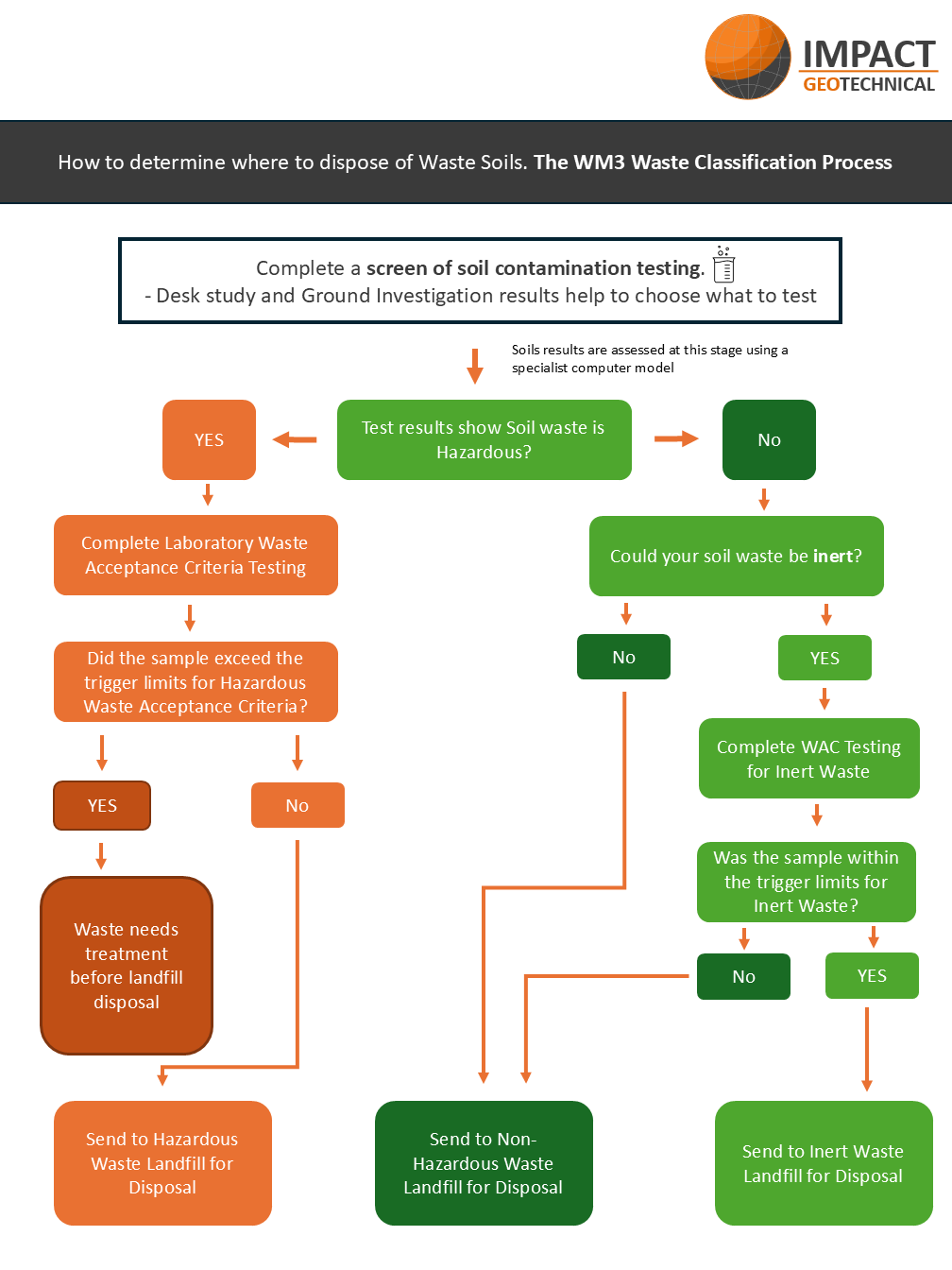
There is often misunderstanding around the purpose of WAC testing. WAC testing does not classify waste as hazardous or non-hazardous.
WAC testing may be required after classification and only when a landfill specifies that WAC results are necessary to determine whether they can accept the waste.
| Purpose | Required For | Performed By |
|---|---|---|
| WM3 Classification | Determines hazardous vs. non-hazardous | Chemical analysis + HazWaste Online |
| WAC | Confirms suitability for disposal site | Requested by receiving facility |
How Impact Geotechnical Can Assist
Waste Testing Services we offer:
- Soil sampling as part of ground investigations or as a standalone service
- Chemical analysis to support WM3 classification
- Assessment of hazardousness through HazWaste Online
- WAC testing where requested by the waste receiver
This approach helps clients understand potential disposal implications early in a project and reduces the risk of unexpected costs or delays.
